How snack manufacturing works in the UAE, and why it matters
TL;DR: Snack food companies in the UAE source raw materials, mix and cook them, season and package under HACCP and ISO 22000 controls, then ship locally or export. Retailers working with food manufacturing companies in Dubai get shorter supply chains, steadier stock, and room for private label. Local snack production is becoming a retail priority as buyers push back against import delays and rising costs.
Shelves move fast in the UAE. A supermarket buyer managing a snack category knows this better than anyone: one late container from overseas, and a bestselling SKU disappears for weeks. That gap is one reason local snack production has become a bigger conversation in retail buying meetings across the Emirates.
This post walks through how snack manufacturing actually works, from raw material sourcing to the final sealed bag on a shelf. It also explains why retailers, wholesalers, and HORECA buyers are paying closer attention to where their snacks come from, not just what's in them.
What does the UAE snack manufacturing landscape look like today?
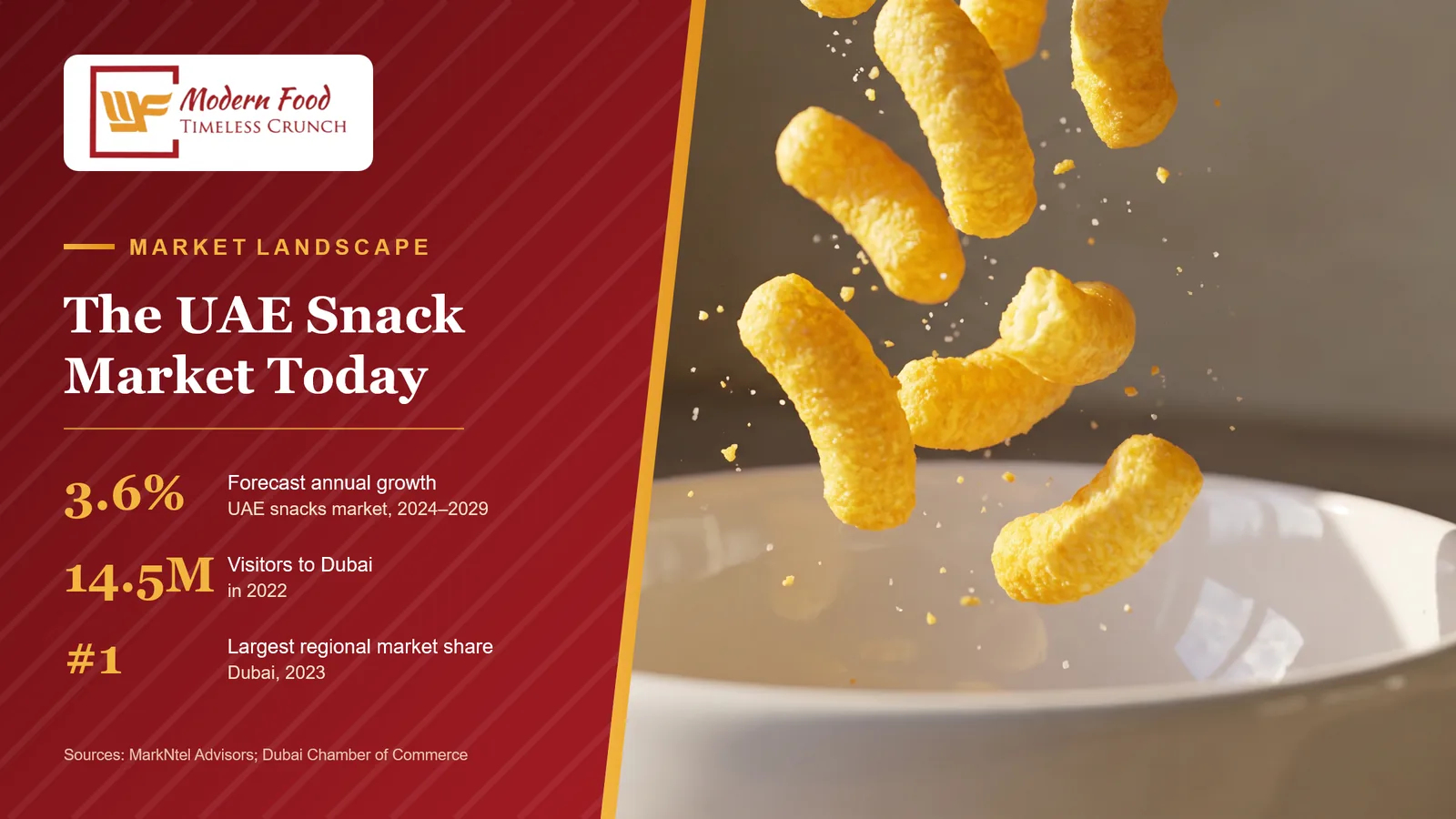
The UAE snacks market is forecast to grow at a compound annual growth rate of roughly 3.6% between 2024 and 2029, according to MarkNtel Advisors' UAE Snacks Market 2024–29 report. Several forces sit behind that growth: rising disposable income, a young population, expanding e-commerce, and a growing female workforce, up from around 53% participation in 2018 to more than 60% in 2023, per the International Labour Organization's 2023 figures, as cited in the same report.
Tourism plays its part too. Dubai welcomed approximately 14.5 million visitors in 2022 and 8.5 million in the first half of 2023 alone, according to the Dubai Chamber of Commerce. Retail sales across the UAE grew around 13% between 2020 and 2022, with roughly 6.6% annual growth expected by 2025 (again, Dubai Chamber figures cited in the MarkNtel report). Dubai itself held the largest regional market share in 2023, driven by festivals, a diverse population, and continuous retail expansion.
Chocolate confectionery led product categories in 2022, but the broader trend worth watching is the shift toward healthier and plant-based snacking, a shift that's reshaping what retailers expect from their suppliers.
Dubai remains the country's manufacturing hub for food production, hosting a concentration of facilities that supply both domestic retail and regional export markets. Trade events reinforce this position. Gulfood Manufacturing regularly draws thousands of exhibitors from dozens of countries to Dubai World Trade Centre, cementing the emirate's role as a production and sourcing centre for the wider region.
What are the core steps in snack manufacturing?
Snack production follows a consistent sequence, whether the end product is a corn ring, a potato chip, or a baked puff.
Raw material sourcing and quality control. Production starts with potatoes, corn, oils, and seasonings, each checked against incoming quality standards before they enter the facility. Reliable sourcing here determines consistency in every batch that follows.
Mixing, cooking, seasoning, and packaging. Ingredients are mixed or sliced, then cooked, typically by baking, frying, or extrusion, depending on the product. Seasoning is applied next, followed by packaging that often includes nitrogen flushing to preserve freshness and metal detection to catch contaminants before sealing.
Food safety certifications and regulatory compliance. UAE manufacturers operate within a framework set by the Emirates Authority for Standardisation and Metrology (ESMA), GSO regional standards, and Dubai Municipality food safety requirements. Halal certification is a standard expectation across the category, not an optional extra.
Technology and automation. Modern facilities increasingly use automated mixing, cooking, and packaging lines to maintain consistency at volume, a factor that matters directly to retailers who need predictable supply, batch after batch.
Why does local production matter to retailers?
For a buyer stocking shelves across multiple stores, the manufacturing process isn't academic: it's the difference between a reliable category and a problematic one.
Supply chain reliability. Local snack production means shorter supply chains. A Dubai-based facility supplying a Dubai-based retailer removes weeks of shipping, customs clearance, and freight uncertainty from the equation. When a supplier is down the road rather than across an ocean, restocking an empty shelf becomes a matter of days, not months.
Cost advantages for wholesale buyers. Cutting freight, warehousing, and import duties out of the cost structure translates into more competitive wholesale pricing: margin that benefits both the retailer and the shopper.
Customisation through private label. Working with a UAE-based manufacturer opens the door to private label and bespoke flavour development in ways that importing a fixed product range simply doesn't. Retailers can commission a flavour exclusive to their own banner, something private label manufacturing partnerships make possible without the long lead times of overseas production runs.
Supporting the local economy and consumer preference. UAE shoppers increasingly favour locally-made products, a preference that aligns with government efforts to position the country as a hub within the global halal food industry, efforts that include facilitating halal certification and promoting halal exports.
What quality assurance and food safety standards should buyers expect?
A retailer evaluating a new snack supplier should look for documented, third-party-verified standards, not just a verbal assurance of quality.
Hygiene protocols and certifications. ISO 22000 and HACCP (Hazard Analysis and Critical Control Points) are the two certifications that matter most in this category. Together, they cover everything from facility hygiene to the identification and control of food safety risks at every stage of production.
Testing for contaminants and shelf life. Manufacturers run testing procedures to check for contaminants and validate how long a product stays fresh and safe to eat: information retailers need to manage inventory and avoid waste.
Traceability systems. Batch coding allows a manufacturer to trace any product back through its production history, an accountability measure that protects both the retailer and the end consumer if an issue ever arises.
How are UAE snack manufacturers building an export advantage?
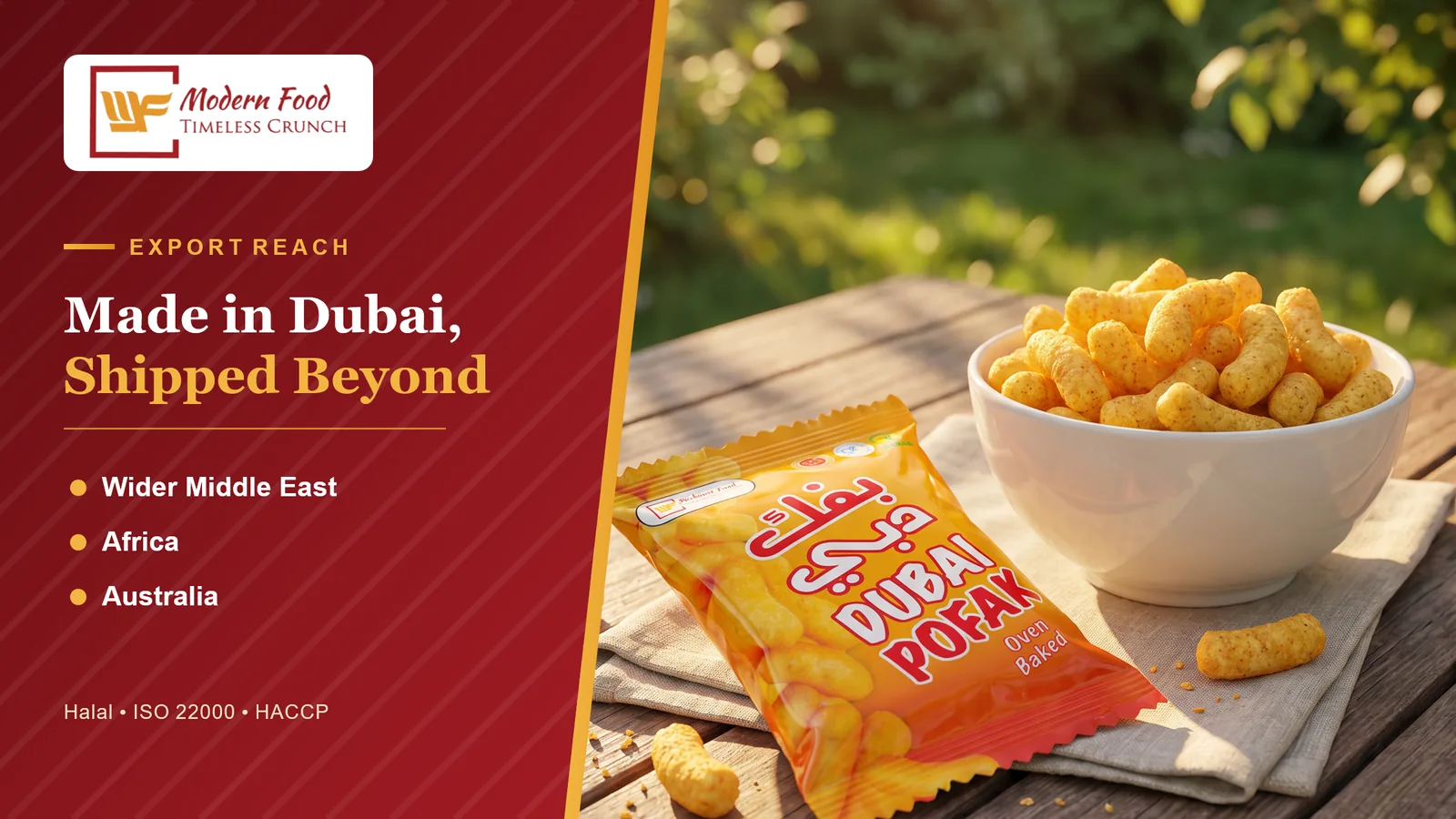
Dubai's manufacturing base doesn't just serve the domestic market. Many UAE snack manufacturers export to the wider Middle East, Africa, and Australia, built on a foundation of halal certification and compliance with international food safety standards.
That export reach works in a retailer's favour too. A manufacturer serving multiple markets typically operates at a scale and consistency that smaller, single-market producers struggle to match, and a strong regional or global reputation adds a layer of trust that benefits every retail partner stocking the brand.
Gulfood Manufacturing remains a key fixture on this calendar, giving international buyers and exhibitors a reason to converge on Dubai each year and reinforcing the emirate's role as a production and trade hub for the category.
What's the strategic value of partnering with a local UAE snack manufacturer?
The case for local sourcing comes down to three things: shorter supply chains, steadier costs, and more flexibility to customise. As the UAE snacks market continues its forecast growth through 2029, retailers who build relationships with food manufacturing companies in Dubai now are better positioned to manage stock, pricing, and range development as the category evolves.
Growth in healthier and plant-based snacking, alongside the country's push toward halal export leadership, points to a sector that will keep expanding its production capacity and its export footprint. Retailers evaluating their supplier base have a clear opportunity to act on that trend rather than wait for it.
Ready to review your snack range? Enquire about wholesale with a locally-based manufacturer and see what shorter lead times and local sourcing can do for your shelves.
Frequently asked questions
- What does it cost to source from a local UAE snack manufacturer compared to importing?
- Local sourcing typically reduces freight, customs, and warehousing costs built into imported stock, which can translate into more competitive wholesale pricing, though exact savings depend on volume, product type, and existing import arrangements.
- How long does it take to restock from a local manufacturer versus an overseas supplier?
- A local Dubai-based supplier can typically restock within days, since there's no ocean freight or customs clearance involved, compared to weeks or months for imported stock.
- What certifications should I look for when choosing a UAE snack food supplier?
- Look for ISO 22000 and HACCP certification as a baseline, along with halal certification, which is standard across the UAE snack category and essential for export to many regional markets.
- Can UAE manufacturers produce private label or custom flavours for my retail brand?
- Yes. Many UAE snack manufacturers offer private label and bespoke flavour development, allowing retailers to commission exclusive products without the lead times associated with overseas production.
- Who are UAE snack manufacturers exporting to?
- UAE-based manufacturers commonly export to the wider Middle East, Africa, and Australia, supported by halal certification and compliance with international food safety standards.